Showing posts with label printing. Show all posts

Monday, May 29, 2017

Technology Outdoors: Week 4 Science Outdoors.

Redshift Swan ©Sue Pownall 2017
As an art teacher to adult students, I was dubious about what this last week could bring in terms of personal inspiration and for my classes.
Unit 2 reintroduced me to the Doppler Effect, which I had forgotten, and continued with RedShift, which I don't recall having ever learnt. However, as I studied physics back in the dark ages, including Einstein's theory of relativity, I assume I must have.

Finishing the unit, I bounced around the internet reading more on this. I liked the simplicity of the illustration below, and found space.com a good site for info, but nasa.gov was a bit complex.

From universevocab.weebly.com
Apart from spending a long time surfing, I continued my exploration of the weekly ideas through my dog walks and took a Doppler effect photo.
Dogwalk Double Doppler Effect
This would not be an image to share with young learners, but from an artistic viewpoint the resulting patterns of colour and light as the cygnets swim towards the swan and she swims towards them could be the beginning of some printmaking patterns. In fact, I have been playing with monoprints based on Redshift and Doppler Effect, here are some of them.
Variations on a theme. ©Sue Pownall 2017
I am sad that this is the last week of the DLabErasmus course, but have an idea to develop the dogwalk images I have created for it.

****** 

If you are looking for my art, you will find it here: www.suepownallartist.co.uk 

Sunday, March 20, 2016

Hello spring!

The gates are open for 2016 at the National Trust's Bourne Mill. ©SuePownall
Today is the Spring Equinox in the northern hemisphere, and spring is one of my favourite seasons. I also like autumn ... and summer ... oh and winter if I'm inside and warm and it's snowing outside.

On Wednesday, I was sketching outside in order to record the 2016 opening of the National Trust property, Bourne Mill. I'm working with the property this year, so rather than sketch the building, other than the outline, I chose to focus on the open gates.

I used a Monologue sketchbook and inked on site. However, I added the watercolour added at home due to icy wind.
St. Patrick's Day. ©SuePownall
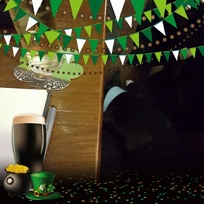
 On Thursday, Saint Patrick's Day provided the opportunity to get some green paint out as I sketched with some friends in a local pub. The above sketch was completed on site, Winsor & Newton watercolour with Staedtlar pen in A5 Daler sketchbook.
Sketching with my assistant.
 More green featured this morning, which is why I'm blogging this evening, as I experimented monoprinting using a Gelli plate. Some of these prints I am thinking of working up, maybe with stencils, or watercolour, or.... not sure. Some as collage backgrounds, maybe. Whilst one will become an Easter card to send to my mum.
Spring monoprint experiments. ©SuePownall
Now, I'm looking forward to lots of garden drawing, flower sketching, and more spring printing.

 What about you? Is spring your favourite season? What are you working on?

Monday, February 29, 2016

Experiments

Stencil on Gelli plate on old damaged book leaf.
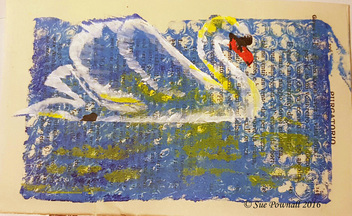
Earlier this week I visited a printmaker friend, Jean Edwards, her work is here, who introduced me to Gelli plates. I really enjoyed it and produced the background above. Once home, I added the stencilled swan. Stencilling is something I have rarely done, but was inspired by Penenlope Dullaghan's homework in Sketchbook Skool.
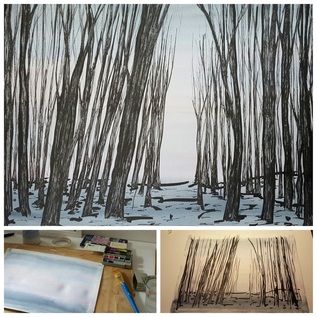
Ink on watercolour wash.
 Those of you who follow me on Instagram ( @suepownallartist15 ) have seen the work in progress on the above piece before. I finished it yesterday, I think, and would appreciate your thoughts on it. Please leave them in a comment below.

***************************************

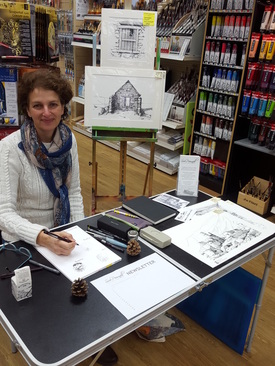
On another matter, yesterday I got to give a pen & ink demo at Tindalls,a local art suppliers. I got to meet some lovely people and look forward to running a workshop for them in March.

Sunday, March 1, 2015

Print workshop induction

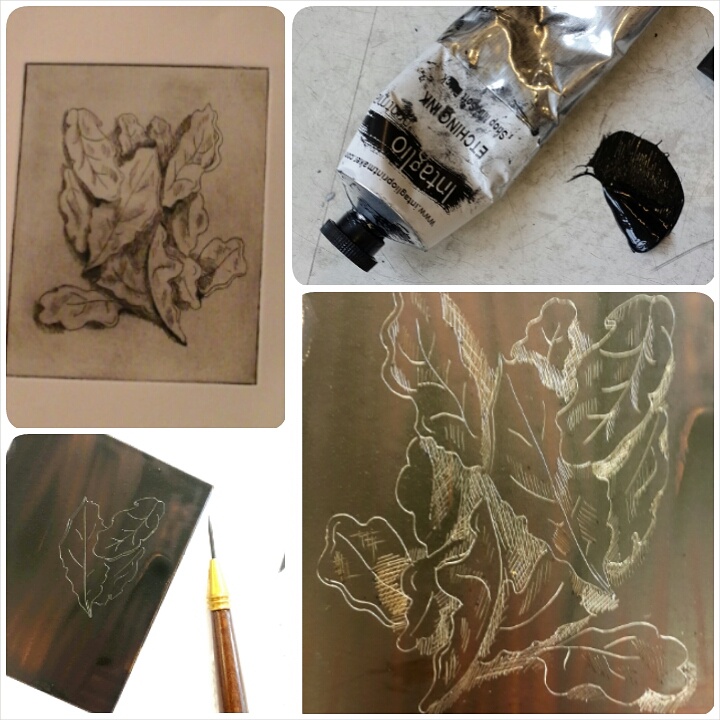
I'm now a member of the print workshop at Cuckoo Farm Studios, Colchester.  Consequently, on Thursday I had my induction to use the workshop unsupervised in the future. Whilst there I took the opportunity to have a 2nd attempt at etching. I used one of my new etching needles, which is quite heavy and a dream to draw with into the hard ground. I redid the oak leaves I'd attempted to etch on my workshop, you can see those results here.

Learning points:
  1. I need to clean the ink off the plates more, as you can see from the print above there is a lot of ink on the background.
  2. I need to pay more attention to the composition. Despite it being an interesting subject (well I think so), as this print doesn't work due to the shape the leaves create... I could use a clean hard ground to work more into this plate, but I'm not sure that will improve a badly thought out compostion.

What printmaking lessons have you learnt?

Sunday, January 25, 2015

Want to come up and see my etchings?

Back in the dim and distant past whilst at college, I had the opportunity to do some etching. This is what I did: 
top basic etching, etchings plus watercolour
 below aquatint plate printed in black and red. Final image combined plates.
When I had my exhibition in December 2013, it was suggested that I should etch, but  I stored the idea until recently when I found a 1-on-1 workshop at Cuckoo Farm Studios with artist & etcher David Stone.
Plate 1 in the acid bath.

On a snowy morning, and starting with a 10x10cm ish piece of metal, I was shown how to apply a soft ground prior to copying a picture of oak leaves. After putting it in acid bath (8:1 solution) I then cleaned the plate off and... found that I hadn't pressed hard enough and there were very few lines etched. Take 2, soft ground prep by me, drawing (this time with a dead biro and a traditional pencil as opposed to the technical pencil I'd first used), acid, clean and...  there were lines. Yay!
 
Then, placing the plate carefully on tissue paper on the press, pre-soaked paper went next, more tissue, then the 3 blankets. After, winding it all through the press, it was a nervous moment to unveil my first print. Nothing stunning, but as this was a workshop it's about learning the process not the results.
1st print from plate 1

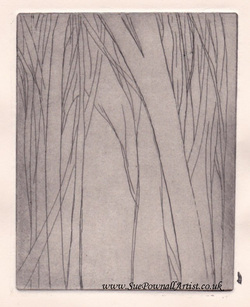
Then it was on to plate 2, to learn and use hard ground. This time I drew lines with an etching needle to make a print of trees. It was funny but I didn't spot the mistake until it was printed. David told me how I could correct the plate, but I chose not to. Both reference photos used were from recent dog walks and they had grabbed my attention as "could draw that" subjects.
 
After cleaning the plates (white spirit to remove ink), it was time to explore aquatint, which I had no recollection of doing at college until I saw the photo.  
 
 
Print from plate 2
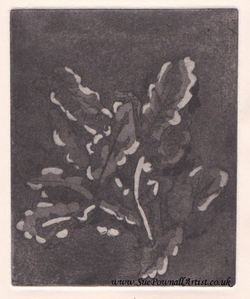
Aquatint from plate 1
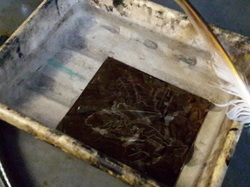
Aquatint is a powdered acid resistant material that was applied over the whole plate. The clean dry plate was put in the box (left) wearing a mask and gloves, then placed on the rack (right) and heated with a scary gas torch from underneath. Once cool, which took moments as I watched the falling snow through the window, I stopped out areas with straw-hat varnish that I didn't want effected. Then it was into the acid bath. Due to the temperature, the grey/time scale based on 24°c was redundant, and David made an educated guess. I built up several tones through stopping out more areas and dipping the plate in acid. The varnish and remaining aquatint were then removed from the plate (white spirit and meths), before it was back to the press... and I was very impressed with the improvement to my first plate (above). So I repeated the aquatint process with the other plate, but reducing the time in the acid bath to just 15 seconds per tone. Here is the result: 
I found the whole workshop inspiring and will soon do an induction in order to use the print facilities reguarly.

Have you tried etching? Or been inspired by a workshop? You are welcome to leave a link to your work in the comments below.

*NOTE: the expression is believed to be an Edwardian euphanism to encourage physical intimacy.